
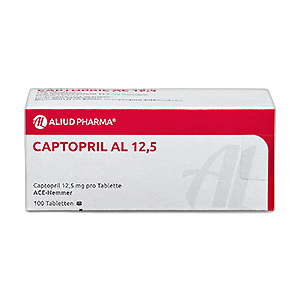
What is captopril?
Captopril was the first approved ACE inhibitor and has been in use since the 1980s. It is used for treating high blood pressure, heart failure, heart attack and diabetic nephropathy.
Captopril is also used in hypertensive crises (blood high pressure emergency). It usually has to be taken two to three times a day, which is a disadvantage over recent ACE inhibitors.
Active Ingredients & Mechanism of Action
Active ingredient: Captopril
Captopril directly inhibits the ACE enzyme:
Active mechanism:
- Direct ACE inhibition (no prodrug)
- Fast action (15-30 minutes)
- Short duration (6-12 hours)
- blood pressure reduction due to vascular expansion
speciality:
- Contains a sulfhydryl group (SH group)
- Fastest impact of all ACE inhibitors
- Can be used sublingually (under the tongue) if required
- Short half-life requires multiple daily intake
Emergency application: In hypertensive crisis, Captopril can put 25 mg under the tongue for rapid blood pressure reduction.
Who is it suitable for?
Captopril is suitable for:
- Adults with high blood pressure
- Hypertensive crisis (blood high pressure emergency)
- Heart failure
- After heart attack
- Diabetic nephropathy (Type 1 diabetes)
Especially suitable:
- If you want quicker action
- Emergency blood pressure reduction
- Diagnostic purposes (captopril test for renal arterial stenosis)
Not suitable:
- Pregnancy and breastfeeding
- Angioedema in History
- Patients who prefer a one-time gift
Available Dosages
High blood pressure:
- start dose: 12.5-25 mg twice a day
- usual dose: 25-50 mg twice a day
- Maximum dose: 150 mg daily
Sufficiency:
- start dose: 6.25-12.5 mg three times a day
- Target dose: 50 mg three times a day
Hypertensive crisis:
- 25 mg sublingual (under the tongue)
Available starches:
- 12.5 mg, 25 mg, 50 mg tablets
How to Take
Intake:
- Two to three times a day
- Take sober (1 hour before eating)
- Meals reduce the intake by 30-40 %
- Take with water
For hypertensive crisis:
- 25 mg tablet put under the tongue
- Slowly disintegrate
- Effect after 15-30 minutes
Important notes:
- Regular laboratory controls (animal, potassium, blood count)
- Do not drop abruptly
- Self blood pressure measurement recommended
Contraindications
**Captopril must not be taken at:* *
- hypersensitivity to captopril or other ACE inhibitors
- Angioedema in History
- Pregnancy and breastfeeding
- Side-sided kidney arterial stenosis
Preview at:
- Restricted kidney function
- Collagenoses (increased risk of blood flow)
- Immunosuppressive therapy
- Aortenstenose
- High potassium level
pregnant: Strikt contraindicates throughout pregnancy.
Possible Side Effects
Acid (1-10%):
- Dry stimulus cough
- Flavour disorders (metallic taste)
- Skin rash
- Squeeze
** Occasionally (0,1-1%):* *
- Blood pressure drop
- Gastrointestinal complaints
- Proteinuria
- Increased potassium values
Selten:
- Angioedema
- Neutropenie/Agranulozytose (especially in renal insufficiency and collagenoses)
- Heavy skin reactions
speciality: Flavour disorders occur more frequently in captopril than in recent ACE inhibitors due to the SH group.
Interactions
Important interactions:
- Potassium-saving diuretics → Hyperkaliemia
- NSAR → reduced effect, kidney damage
- Lithium → raised mirrors
- Antazida → reduced intake of captopril
- Probeecid → increased captopril mirror
Court: Meals reduce bioavailability by 30-40%. Sober intake recommended.
Preview:
- Allopurinol (sensitivity reactions)
- Procainamide (blood image changes)
Frequently Asked Questions
Similar Medications
Is captopril right for you?
A licensed doctor will review your information and issue a prescription if suitable. Discreet and secure.
Important Notice
This information does not replace medical advice. If you have questions about your health or the suitability of this medication, please consult a doctor. Read the package leaflet before use.