
Overview
In this section you will get an overview of the condition and its relevance to your health.
Vitamin D plays a central role in bone, muscle, and immune system health. Many people in Germany do not achieve sufficiently high vitamin D levels, especially during the winter months, because sunlight -- the most important source -- is lacking.
A vitamin D deficiency often goes unnoticed for a long time or presents nonspecifically through fatigue, muscle weakness, or diffuse pain. With severe deficiency, the risk of bone diseases such as osteomalacia or osteoporosis increases.
The good news: a vitamin D deficiency can be well diagnosed and safely treated -- usually through supplementation with cholecalciferol. The appropriate dosage can also be discussed as part of an online consultation.
What is it?
Here you will learn what medically characterizes this condition and how it is defined.
Vitamin D is, strictly speaking, a hormone precursor. The body primarily produces it in the skin under UVB light. It is then converted into active forms in the liver and kidneys.
Vitamin D regulates calcium and phosphate metabolism and is therefore crucial for:
- Bone mineralization
- Muscle strength
- Immune system function
The marker typically measured is 25(OH)-vitamin D in the blood.
Causes
The following information explains which factors can contribute to the development of this condition.
A deficiency occurs when too little vitamin D is produced or absorbed.
Insufficient sunlight is the most common cause (winter, predominantly indoor lifestyle, sun protection, darker skin).
Other risk factors:
- Older age
- Overweight
- Certain intestinal diseases (malabsorption)
- Kidney disease
- Strict covering clothing, low UV exposure
Diet alone often does not reliably cover the requirement.
Symptoms
This section describes the typical signs and symptoms you should watch for.
Mild deficiencies are often symptom-free.
Possible symptoms:
- Fatigue, exhaustion
- Muscle weakness, muscle pain
- Bone pain
- Increased susceptibility to infections (nonspecific)
With severe deficiency, bones can demineralize (osteomalacia), and the risk of falls may increase.
Warning signs: severe bone pain, repeated fractures, or severe muscle weakness should be medically evaluated.
Diagnosis
Below you will learn how this condition is detected through medical examinations.
Diagnosis is made through a blood test: 25(OH)-vitamin D.
Depending on the situation, the following may also be checked:
- Calcium, phosphate
- Parathyroid hormone
- Kidney values
As part of an online consultation, laboratory values can be interpreted and a supplementation plan created.
Treatment
Here the available therapy options and their modes of action are explained.
Treatment is usually with vitamin D supplements.
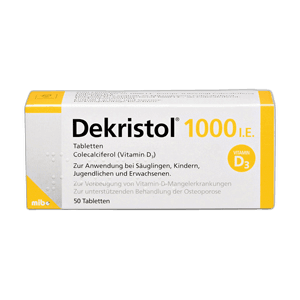
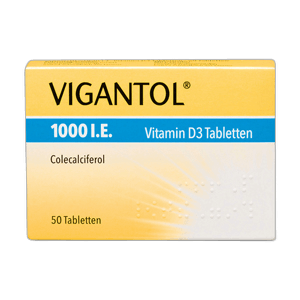
Cholecalciferol (vitamin D3) is the standard. Dosage depends on baseline levels, body weight, and risk.
- For mild deficiency, a daily or weekly maintenance dose is often sufficient.
- For severe deficiency, a higher short-term dose may be given, followed by maintenance.
Possible side effects are rare and occur primarily with overdosing (e.g., elevated calcium levels with nausea, thirst, frequent urination).
Important contraindications: certain forms of hypercalcemia or kidney stones require medical evaluation.
Available medications
Various prescription medications are available for treatment. Click on a medication to learn more about its effects, dosage and side effects.
Prevention
This section provides guidance on prevention and reducing risk factors.
Prevention:
- Regular moderate sun exposure (without sunburn)
- For those at risk: maintenance dose during sun-poor months
- Balanced diet (fatty fish, eggs), though this alone is often insufficient
Medical monitoring is advisable for at-risk groups.
FAQ
Here you will find answers to frequently asked questions on this topic.
Would you like a medical assessment?
Fill out the medical questionnaire. A licensed doctor will review your information and recommend a suitable therapy if appropriate.
Important notice
This content is for general information only. In case of severe pain, shortness of breath, impaired consciousness, fever > 39°C or rapidly worsening symptoms, please seek immediate medical help ().
Related treatments
More treatments from the Allgemeine Medizin area that might interest you.
Asthma
Wir prüfen Beschwerden und mögliche Warnzeichen, damit der nächste Schritt sicher eingeordnet werden kann.
Medizinisches Cannabis
Kurzer Check zu Beschwerden, Vorerkrankungen und bisherigen Therapien zur medizinischen Einordnung.
Allergischer Schnupfen (Heuschnupfen)
Ein kurzer Fragebogen hilft, Symptome, Auslöser und bisherige Behandlung zu erfassen.
Raucherentwöhnung
Kurzer Check zu Konsum, Motivation und Rahmenbedingungen – für passende Optionen.