
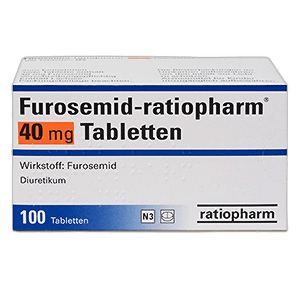
What is furosemide?
Furosemid is a grinding diuretic and the strongest orally available dewatering medication. It is used in edema (water retention) of various causes, in particular in the case of heart failure, kidney diseases and cirrhosis. It can also be used in the case of high blood pressure, in which case thiazidiuretics are generally preferred.
The name derives from his place of activity: the Henle loop in the kidney. Furosemid causes rapid and vigorous water separation. It is available as tablets, injection solution and drops. Known preparations are Lasix®, Furosemid-ratiopharm® and Furosemid AL®.
Furosemid has a rapid action and is therefore also used in emergency situations (e.g. acute lung edema).
Active Ingredients & Mechanism of Action
Active ingredient: Furosemid
Furosemid inhibits the sodium potassium 2-chloroid cotransporter (NKCC2) in the Henle loop:
Active mechanism:
- inhibits the resorption of sodium, potassium and chloride in the Henle loop
- Large amounts of water follow osmotically the electrolyte
- Strong diuresis (water separation)
- Fast reduction of blood volume
Activity:
- Strongest oral diuretic
- Can precipitate up to 15-25% of the filtered sodium
- For comparison: Thiazide only 5-8 %
Additional effects:
- Venous vasodilatation (preload reduction) – works already before the diuresis
- Increased calcium and magnesium precipitation
- Increased uric acid retention
Initiation of action: Oral: 30-60 minutes. Intravenous: 5-15 minutes. Duration: 4-6 hours. A counterregulation (rebound sodium retention) can then occur.
Who is it suitable for?
Furosemid is suitable for:
- Edema in heart failure
- Edema in kidney disease
- Edema in liver cirrhosis
- Lung edema (emergency)
- High blood pressure (if Thiazide is not sufficient)
- Forced diuresis in poisoning
Especially suitable for:
- Heart failure with liquid overcharging
- Kidney insufficiency (GFR under 30 ml/min – Thiazide hardly works here)
- Acute lung edema (emergency)
- Heavy edema that does not respond to Thiazide
Not suitable:
- Single continuous therapy for high blood pressure (thiazides prefer)
- Anurie (falling urine production)
- Heavy hypokalemia
- Heavy hyponatriemia
- Precious hepatic encephalopathy
Available Dosages
Edema:
- Start dose: 20-40 mg once a day (morgens)
- usual dose: 40-80 mg daily
- Maximum dose: 600 mg daily (with severe kidney failure)
- Can be divided into 2 gifts if required
High blood pressure:
- 20-40 mg once or twice a day
Lung edema: 40-80 mg i.v.
Available starches:
- 20 mg, 40 mg, 250 mg, 500 mg tablets
- Injection solution
- Oral solution
Dosis adjustment for kidney failure: Higher doses are frequently required at GFR below 30 ml/min (up to 250-500 mg).
How to Take
Intake:
- Take in the morning (to avoid nightly urging)
- With two gifts: morning and midday (not evening)
- Independent meals
- With sufficient water
Important notes:
- Regular laboratory controls: electrolytes (potassium!), kidney values, blood sugar
- Drink sufficient (according to medical instructions)
- Potassium-rich diet (bananas, potatoes, nuts)
- Control weight regularly (Note on dewatering/watering)
- In case of severe diarrhea or vomiting: contact doctor (dehydration risk)
- observe sun protection (photosensitising possible)
Contraindications
**Furosemid must not be taken at:* *
- Anurie (no urine production)
- Heavy hypovolaemia or dehydration
- Heavy hypokalemia
- Heavy hyponatriemia
- Precious or comatious hepatic encephalopathy
- hypersensitivity to furosemide or sulfonamides
Preview at:
- Diabetes mellitus (blood sugar increase possible)
- Gout/hyperuremia (increased uric acid)
- Liver cirrhosis with ascites
- At the same time taking ototoxic medicines
- Prostate hyperplasia (resin retention possible)
- Porphyry
pregnant: Only with strict indication. Furosemid passes the placenta and can increase the diuresis during fetus.
Possible Side Effects
Acid (1-10%):
- Hypokaliemia (calium deficiency) – main side effect!
- Hyponatriemia
- Dehydration
- Hypotonia
- Increased uric acid
- Metabolic changes (blood sugar, blood fats)
** Occasionally (0,1-1%):* *
- dizziness, headache
- Muscle cramps
- Gastrointestinal complaints
- Skin rash
- photosensitization
- hearing disorders (especially at faster i.v.-Gabe)
Selten:
- Heavy electrolyte disorders
- Pancreatitis
- Blood-image changes
- Kidney function reduction
- Ototoxicity (irreversible at very high doses)
Important: Potassium loss is the most common and most dangerous side effect. Regular potassium controls are mandatory! potassium substitution or combination with potassium-saving diuretic.
Interactions
Dangerous combinations:
- Aminoglycoside antibiotics (genetamicin) → enhanced ovtotoxicity and nephrotoxicity
- Cisplatin → increased kidney and hearing damage
- Lithium → increased lithium level (toxic!)
Preview at:
- Digitalis preparations → Potassium loss strengthens digitalis toxicity!
- ACE-Hemmer/Sartane → increased hypotension, kidney function disorder
- NSAR → reduced diuretic effect, kidney damage
- Corticosteroids → increased potassium loss
- Antidiabetics → reduced blood sugar reduction
- Sucralfat → reduced furosemid absorption (2 hours distance)
Important: When taking Digitalis (Digoxin) at the same time, the potassium level must be carefully monitored. Hypokaliemia increases the risk of life-threatening heart rhythm disorders.
Frequently Asked Questions
Similar Medications
Is furosemide right for you?
A licensed doctor will review your information and issue a prescription if suitable. Discreet and secure.
Important Notice
This information does not replace medical advice. If you have questions about your health or the suitability of this medication, please consult a doctor. Read the package leaflet before use.