
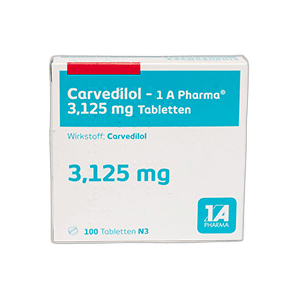
What is carvedilol?
Carvedilol is a third-generation beta blocker with a unique profile: it not only blocks beta-1 and beta-2 receptors, but also alpha-1 receptors. This triple block leads to a particularly effective reduction in blood pressure and a relief of the heart.
Carvedilol is particularly well studied in chronic heart failure and in large studies (COPERNICUS, COMET) has reduced mortality in heart failure. It is used in high blood pressure, chronic heart failure and coronary heart disease.
Carvedilol must be taken twice a day due to the additional alpha blockade. Available preparations include Carvedilol-ratiopharm® and Dilatrend®.
Active Ingredients & Mechanism of Action
Active ingredient: Carvedilol
Carvedilol has a threefold mechanism of action:
Beta-1 blockade (in the heart):
- Lowers heart rate and impact strength
- Reduces oxygen consumption
- Inhibits renin release
Beta-2 blockade (on lungs and vessels):
- Non cardioelective
- Cave: Bronchospasmus at Asthma possible
Alpha-1 blockade (on the vessels):
- Extends peripheral blood vessels
- Lowers the vascular resistance
- Reduces the back load of the heart
- Improves blood circulation
Additional properties:
- Antioxidant action
- Stabilization of cell membranes
- No negative influence on insulin sensitivity
- Cheap effects on fat metabolism
Initiation of action: Maximum blood pressure reduction after 1-2 hours. Stable setting after 1-2 weeks.
Who is it suitable for?
Carvedilol is suitable for:
- Adults with high blood pressure
- Chronic stable heart failure (NYHA II-IV)
- Chronic stable angina pectoris
Especially recommended at:
- Heart failure (strong study documents)
- High blood pressure with increased peripheral resistance
- Patients after heart attack
- Liver cirrhosis with portal hypertension (off-label)
Not suitable:
- Heavy asthma bronchiale (not cardioselective!)
- AV block II/III. Grades
- Heavy bradycardia
- Decompensated heart failure
- Heavy liver failure
- Cardiogenic shock
Available Dosages
High blood pressure:
- start dose: 12.5 mg once a day (1 and 2 days)
- Then 25 mg once or twice a day
- Maximum dose: 50 mg daily (divided)
Sufficiency:
- start dose: 3,125 mg twice a day
- Increase every 2 weeks: 6.25 mg → 12.5 mg → 25 mg (each 2x)
- Target dose: 25 mg twice a day (up to 85 kg) or 50 mg twice a day (over 85 kg)
Angina pectoris:
- start dose: 12.5 mg twice a day
- After 2 days: 25 mg twice a day
Available starches:
- 3.125 mg, 6.25 mg, 12.5 mg, 25 mg tablets
How to Take
Intake:
- twice a day (morning and evening)
- Take meals (better compatibility, slower intake)
- With sufficient water
- Patients with heart failure: slowly rise (orthostatic hypotension)
For heart failure:
- Very slow dose increase (all 2 weeks)
- Start with stable heart failure
- Medical supervision
- In case of deterioration: reduce dose
Important notes:
- Do not drop abruptly
- Regular blood pressure, pulse and weight controls
- Asthmatiker: Carvedilol is not suitable (not cardioselective)
Contraindications
**Carvedilol must not be taken at:* *
- hypersensitivity to carvedilol
- Decompensated heart failure (i.v. therapy necessary)
- Heavy liver failure
- AV-Block II./III. Grades (without pacemaker)
- Heavy bradycardia (under 50/min)
- Sick sine syndrome
- Cardiogenic shock
- Heavy hypotension (under 85 mmHg systolic)
- Asthma bronchiale or heavy COPD
- Untreated phenochromocytoma
Preview at:
- Diabetes mellitus (can mask hypoglycemia symptoms)
- Peripheral blood circulation disorders
- Prince metal angina
- Contact lens support (reduced tear fluid)
- Psoriasis
pregnant: Contraindicated. Betablockers can lead to growth delay and bradycardia in newborns.
Possible Side Effects
Very common (over 10%):
- Squeeze
- Headaches
- fatigue (especially at the beginning)
Acid (1-10%):
- Bradykardie
- Orthostatic hypotension (especially in heart failure)
- Edema
- Weight gain
- Gastrointestinal complaints
- visual disorders
- Reduced tear fluid
** Occasionally (0,1-1%):* *
- Depressive detunement
- Sleep disorders
- Potency disorders
- Skin rash
- Breath, bronchospasmus
- Blocking
Selten:
- Heavy allergic reactions
- Deterioration of kidney function
- thrombocytopenia
- Reinforcement of Psoriasis
** Orthostatic dizziness occurs especially at the start of therapy and dose increase. Slow up is recommended.
Interactions
Contraint with:
- MAO inhibitors (except MAO-B inhibitors)
Preview at:
- Digoxin → increased digoxin level
- Insulin and Antidiabetics → Hypoglycemia masking and strengthening
- Rifampicin → reduced carvedilol mirror
- Cyclosporin → increased cyclosporin levels
- Clonidine → Rebound effect with simultaneous settling
- Narcotics → increased hypotension and bradycardia
- CYP2D6 inhibitors (fluoroxetin, paroxetin) → increased carvedilol levels
Important: Carvedilol is metabolized via CYP2D6 and CYP2C9. These enzymes can intensify the action of carvedilol.
Frequently Asked Questions
Similar Medications
Is carvedilol right for you?
A licensed doctor will review your information and issue a prescription if suitable. Discreet and secure.
Important Notice
This information does not replace medical advice. If you have questions about your health or the suitability of this medication, please consult a doctor. Read the package leaflet before use.